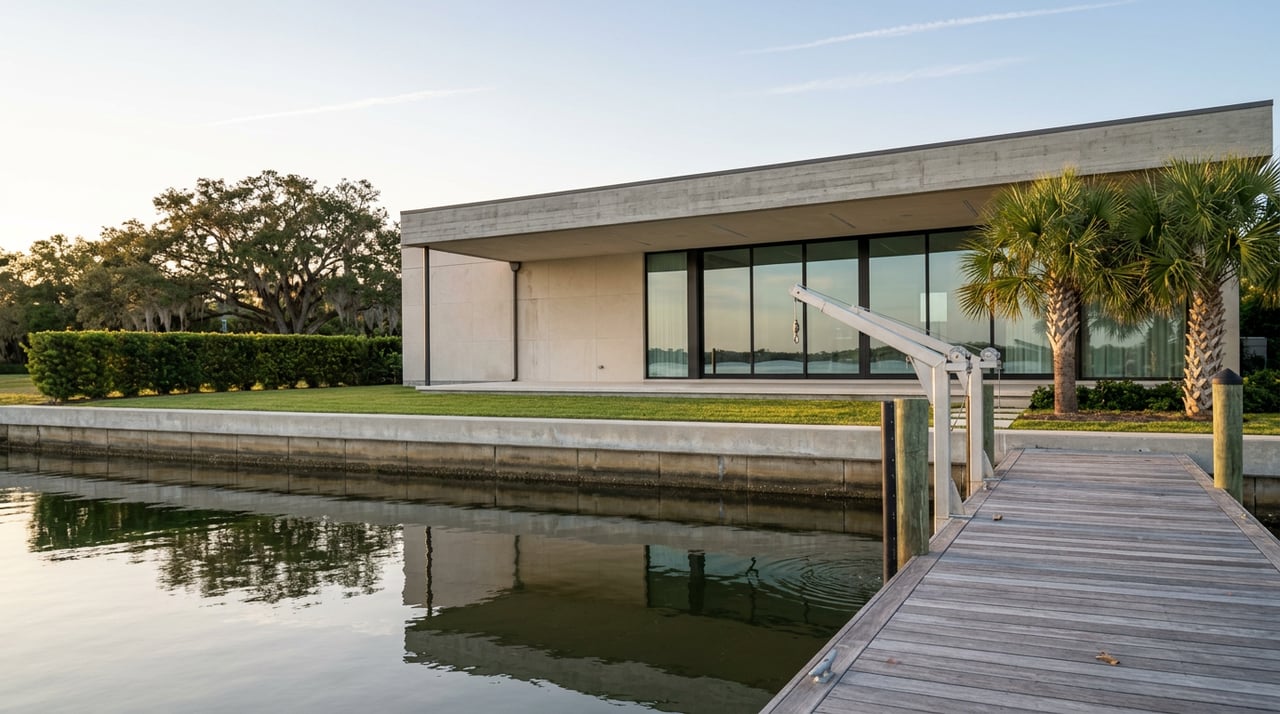
In February 2026, a waterfront lot at 1608 Culbreath Isles Drive sold for $2.4 million. It was marketed as the only available homesite in the entire gated community, and it found a buyer in four days. That same month, waterfront homes across Beach Park, a neighborhood a few minutes away and marketed with nearly identical language about docks, deep water, and boater access, were sitting on the market for months.
The gap is not about finishes or square footage. Both neighborhoods sell an identical premise: a home on Old Tampa Bay with room for a boat. What separates a four-day sale from a five-month listing is something that never shows up in the photos. It is the condition of the seawall, the paper trail behind the dock, and whether the deed actually carries the legal right to be there in the first place.
The Four-Day Sale and the Five-Month Listing
Culbreath Isles is a small, gated enclave of roughly 200 homes built mostly in the 1960s, sitting west of Westshore Boulevard with deep-water docks on most of its waterfront lots. Redfin's February 2026 snapshot put the neighborhood's median sale price at $2.4 million with a median of just 4 days on market. Zillow's home value index for the same window placed typical value near $3.07 million, up 3.8% over the prior year.
Beach Park tells a different story depending on which slice of the neighborhood you look at. Redfin's broader February 2026 snapshot for Beach Park, which mixes inland and waterfront homes, showed a $763,000 median sale price and 146 median days on market. Narrow that to waterfront-only listings and the picture shifts again: a May 2026 pull showed 13 waterfront homes for sale at a median listing price of $1.15 million, typically sitting 95 days before going under contract. Zillow's Beach Park value index, meanwhile, showed typical value down 7.1% year over year, with 41 homes in active inventory.
Two neighborhoods, both selling water access, both within a short drive of Tampa International Airport, and one moves in days while the other moves in months. The obvious explanation is scarcity. Culbreath Isles has 200 homes and a waiting-game buyer pool. Beach Park has more inventory and more variety. That explanation is true, but it is not the whole mechanism.
What the Price Per Square Foot Doesn't Show You
Every waterfront home on this stretch of the peninsula comes attached to three things a listing sheet rarely details in full: a seawall, a dock with its own permit history, and a set of riparian rights that determine what you can actually build or keep in the water. None of these are optional add-ons. They are part of what you are buying, and their condition varies enormously from lot to lot even on the same street.
The seawall market along this part of Tampa Bay is concentrated in exactly four neighborhoods: Beach Park, Sunset Park, Culbreath Isles, and Davis Islands, all of which took on storm surge damage during Hurricane Helene in September 2024 and wind damage from Hurricane Milton shortly after. The repair and replacement market has stayed backlogged into 2026, with costs running roughly $300 to $900 per linear foot for repair work and $350 to $1,200 per linear foot for full replacement. Depending on the length of the wall, that range is the difference between a five-figure repair and a project that rivals a full home renovation.
Permitting adds another layer. Work in Hillsborough County routes through county development services, with the Tampa Port Authority handling marine construction in tidal waters and delegating authority to the Environmental Protection Commission for single-family residential projects. Federal sign-off typically comes through Florida's State Programmatic General Permit for routine docks. None of this is disclosed on a listing sheet. It shows up only when someone asks for it.
One Enclave, One Era, One Story
Culbreath Isles compresses this uncertainty in a way Beach Park cannot. The community was largely built out in a single decade under one HOA, with a guarded, gated entrance and decades of shared maintenance norms. Most of the waterfront lots carry deep-water docks that were built to a similar standard around the same time, and buyers shopping this enclave are, in effect, relying on a track record the whole neighborhood shares. That is part of why a listing here can move in four days. The unknowns are smaller because the community has already spent sixty years working through them together.
Beach Park does not offer that same shorthand. It is a wider, more varied stretch of canal-front and bay-front lots built across different decades, under no single association overseeing waterfront infrastructure. Every seawall and every dock permit is its own research project. That is very likely a real driver behind the 95 to 146 day range on market: buyers and their agents are spending that time chasing down permit records, inspection history, and dock condition on a house-by-house basis rather than trusting a shared neighborhood standard.
What Actually Transfers With the Deed
The riskiest assumption a buyer can make on this stretch of water is that "waterfront" automatically means full water rights. Florida law recognizes a bundle of riparian rights tied to property that reaches the mean high-water line, including the right to build a dock, sometimes called the right to wharf out. But the state owns the submerged land beneath navigable water, and a property's legal boundary has to actually reach that line for the rights to attach.
Florida courts have ruled against owners who assumed otherwise. In Whetstone v. City of St. Augustine, a Florida appellate court found that a gap in the chain of title between the property and the navigable water meant the owner had no riparian rights and no legal basis to build a dock, regardless of how the property looked from the water. Standard title insurance does not automatically cover riparian rights either. Insuring a waterfront purchase properly usually requires a property-specific exception and a survey that maps the actual riparian line, not just the upland lot boundary.
The Davis Islands Timeline Problem
Davis Islands adds a municipal layer to the same underlying issue. The city's public boat ramp at 846 Severn Avenue in the Seaplane Basin offers one ramp, two lanes, a dock, trailer parking, and 24-hour access, which covers day-to-day boating needs. But the city's own project page shows a $1.5 million initiative to replace failing docks and add a mooring field with navigation aids in the Seaplane Basin, currently in the design phase with construction targeted for 2027 to 2028. As of mid-2026, the city also listed Marjorie Park Marina as out of service following hurricane damage. For a buyer weighing slip access as part of the purchase, the relevant question is not just what exists today but what timeline the city is actually working on.
A Quick Comparison
| Neighborhood | Snapshot date | Price measure | Time on market |
|---|---|---|---|
| Culbreath Isles | February 2026 | $2.4M median sale price | 4 days |
| Beach Park, waterfront only | May 2026 | $1.15M median listing price | 95 days |
| Beach Park, all homes | February 2026 | $763K median sale price | 146 days |
Sunset Park sits between these two stories. Its waterfront streets, named after famous poets according to the City of Tampa, mix directly with inland blocks, giving buyers a wider range of price points than Culbreath Isles offers but the same underlying question on every lot: what is the seawall's real condition, and does the dock's permit history actually check out.
What to Ask For Before You Write an Offer
- The original dock and seawall construction permit, plus any subsequent repair permits
- The current sovereignty submerged lands lease number, if the dock extends over state-owned bottom
- A survey that shows the riparian line, not just the upland lot boundary
- Recent inspection history for the seawall, including any tieback or cap repairs
- Confirmation of insurance coverage for the dock, since it is often excluded from a standard homeowner's policy
If a seller cannot produce this paperwork, it is not automatically a reason to walk away. It is a reason to build the review into your inspection period rather than assume it later.
Frequently Asked Questions
Who is responsible for seawall repairs, the buyer or the seller? In Florida, the property owner fronting the seawall is generally responsible for its condition. In a sale, that responsibility shifts to whoever holds title at closing, which makes seawall condition a negotiation point rather than an afterthought.
Does a waterfront listing always come with the right to keep a dock? Not automatically. Riparian rights depend on the property's legal boundary actually reaching the water, which is why a survey and a title review matter more here than on an inland purchase.
How long is the current wait for seawall repair or replacement in this market? As of 2026, the local seawall repair and replacement market remains backlogged following the 2024 hurricane season, with both cost and lead time elevated compared to prior years.
A waterfront price tag in South Tampa is really three prices layered together: the house, the shoreline infrastructure, and the legal right to use it. Sorting out which one you are actually paying for is easier with someone who has already asked these questions on this stretch of water. James Heeley works with buyers across Culbreath Isles, Beach Park, Sunset Park, and Davis Islands who want that sorted out before they write an offer, not after. Let's Connect.